Dendritic branch structure compartmentalizes voltage-dependent calcium influx in cortical layer 2/3 pyramidal cells
eLife · 2022
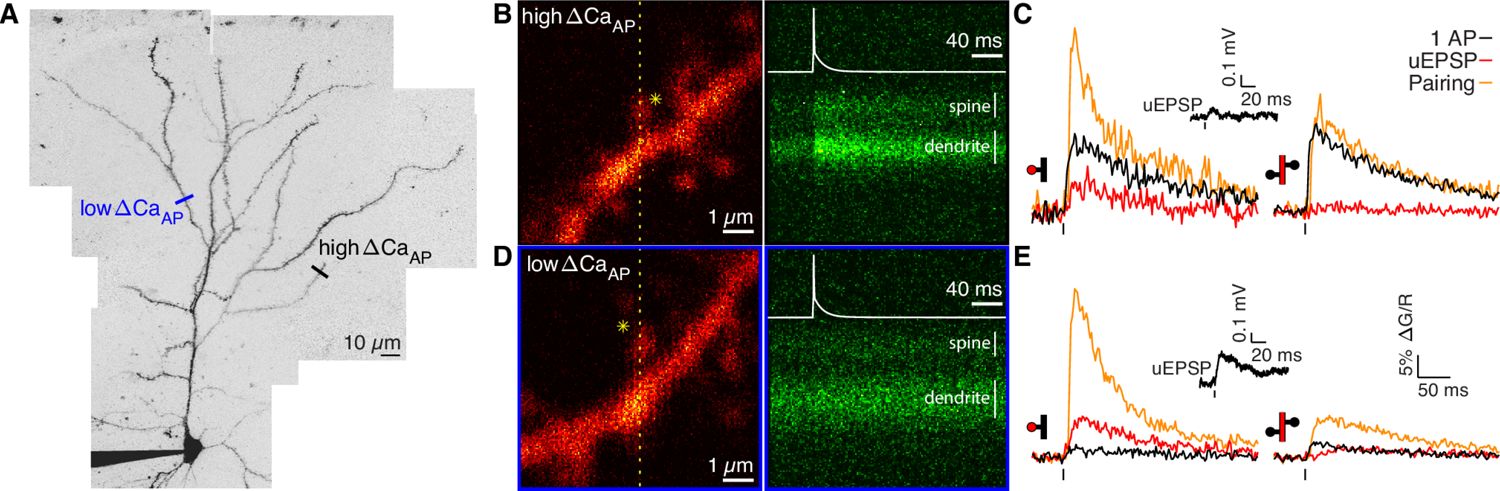
When a neuron generates an action potential, it back-propagates into the dendrites, where it can evoke calcium influx and influence synaptic plasticity. We asked whether action potentials evoke similar calcium influx in sister dendritic branches.
Using two-photon calcium imaging, glutamate uncaging, and whole-cell electrophysiology in mouse cortical slices, we found that an action potential could evoke a strong calcium response in one branch and very little in a nearby sister branch. In a biophysical model, differences in the shape of the dendritic tree were sufficient to reproduce this effect. This suggests that branch geometry can shape how a neuron’s own spikes influence learning at individual synapses.