A NPAS4–NuA4 complex couples synaptic activity to DNA repair
Nature · 2023
When neurons become active, they produce NPAS4, a protein that helps switch on genes in response to activity. This study found that NPAS4 joins the NuA4 complex and helps recruit DNA repair machinery to regulatory regions that are repeatedly damaged when neurons are active.
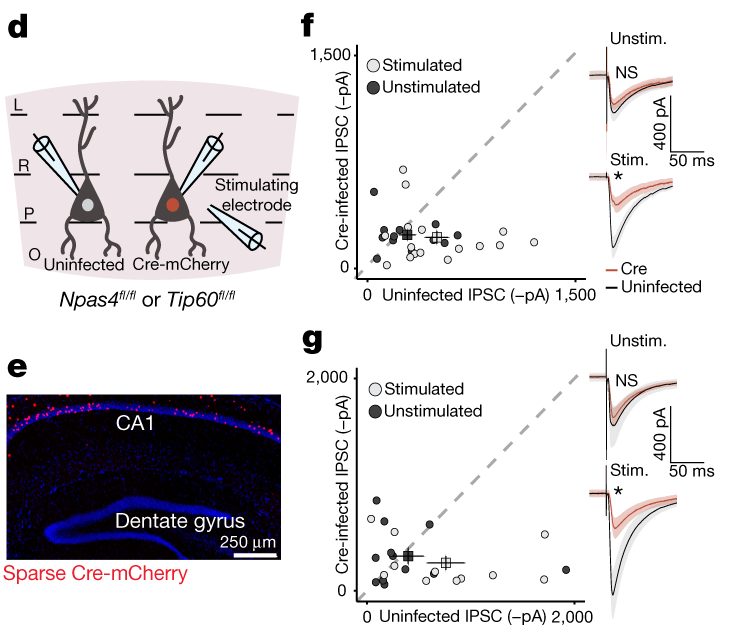
I contributed to the impressive tour-de-force of the lead authors by measuring if TIP60, a key protein in the NuA4 complex, shares a similar function as NPAS4 in recruiting synaptic inhibition. In mouse hippocampal slices, we recorded inhibitory currents from pairs of neighboring CA1 pyramidal neurons that were either control cells or had a selective knockout of NPAS4 or TIP60. Deleting either NPAS4 or TIP60 reduced the increase in inhibition at the cell body after stimulation. This demonstrates that the effects of NPAS4 are likely mediated through the NuA4 complex.
Why care? Well, the NuA4 complex is interesting, it’s involved in many functions, including DNA repair. By linking NPAS4 function to the NuA4 complex, we showed that a key function of activity-dependent transcription in neurons is to repair DNA damage caused by that transcription. This matters for neurons because they live our whole lives, so have to work harder to preserve their DNA integrity than other cells.